Launching a women’s clothing collection can be an exciting opportunity for a fashion brand, but turning a product idea into a finished garment requires careful planning. One of the most important decisions is finding a reliable women’s t-shirt manufacturer that understands your requirements and can consistently deliver the quality your customers expect.
Whether you are building a new fashion brand, expanding an existing clothing business, launching a private label collection, or selling apparel through an online store, the manufacturing process involves many stages. Design, fabric selection, pattern development, sampling, printing, labeling, bulk production, quality control, packaging, and shipping all need to work together.
Understanding how the process works can help brands communicate more effectively with manufacturers and avoid common production problems.
Why Manufacturing Preparation Matters
Many apparel production problems begin before the first garment is even manufactured.
A design may look excellent on a computer screen but require adjustments when converted into a physical garment. A fabric that looks attractive in a sample book may not have the right weight or stretch for the final design. A printed graphic may need to be resized because of the garment’s shape.
This is why a professional women’s t-shirt manufacturer should be involved early in the product development process.
Clear communication between the brand and manufacturer can help answer important questions before production begins.
For example:
- What fabric should be used?
- What is the desired T-shirt weight?
- What is the target fit?
- Where should the logo be placed?
- Which printing technique is appropriate?
- What is the required size range?
- How many pieces are needed?
- What is the target delivery date?
- What packaging is required?
The more clearly these requirements are defined, the easier it becomes to produce the intended product.
Step 1: Define Your Product Concept
Before contacting a manufacturer, brands should have a clear idea of what they want to produce.
You do not necessarily need a completely finished technical package. However, having basic information can make the initial discussion much more productive.
Start by defining the type of T-shirt you want.
For example, your product could be:
- Oversized women’s T-shirts
- Basic cotton T-shirts
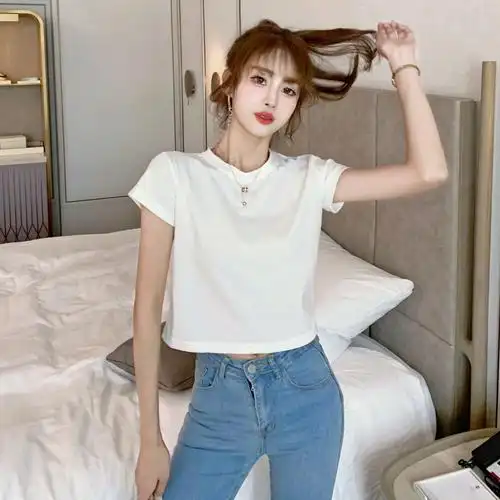
- Cropped T-shirts
- Fitted women’s T-shirts
- Graphic T-shirts
- Vintage-style T-shirts
- Premium heavyweight T-shirts
- Organic cotton T-shirts
- Promotional T-shirts
- Private label T-shirts
You should also consider your target customer.
A T-shirt designed for teenagers may have a different fit and aesthetic from one designed for professional women or luxury fashion customers.
Your target retail price is also important because fabric, construction, decoration, and finishing options all affect manufacturing costs.

Step 2: Prepare Your Design Information
A good women’s t-shirt supplier needs enough information to understand your product.
If you have professional fashion design files and a tech pack, provide them to the manufacturer.
A detailed tech pack can include:
- Technical drawings
- Garment measurements
- Fabric composition
- Fabric weight
- Color references
- Stitching requirements
- Print artwork
- Embroidery artwork
- Label specifications
- Packaging instructions
- Size specifications
If you do not have a complete tech pack, a manufacturer with product development experience may still be able to help develop the garment based on your concept.
Monsoon Apparel describes its manufacturing process as including design and concept development, technical specifications, prototyping, sample approval, mass production, packaging, and shipping.
This type of support can be especially valuable for startups that have strong creative ideas but limited technical apparel experience.
Step 3: Select the Right Fabric
Fabric selection has a major impact on the appearance, comfort, and durability of a T-shirt.
Cotton is one of the most common choices for women’s T-shirts because it offers softness and breathability. However, cotton comes in many different constructions and weights.
A lightweight fabric may be appropriate for a summer collection, while a heavyweight fabric can provide a more structured streetwear appearance.
Stretch fabrics can be useful for fitted styles, while blends may provide specific performance or durability characteristics.
When discussing fabric with your custom women’s t-shirt manufacturer, consider the following:
Fabric Weight
Fabric weight affects how thick, heavy, and structured the garment feels.
Composition
Different fiber combinations can influence softness, stretch, durability, breathability, and care requirements.
Hand Feel
The fabric should provide the tactile experience expected by your target customers.
Shrinkage
Shrinkage should be evaluated before bulk production so that finished garment measurements remain within acceptable tolerances.
Colorfastness
The fabric should maintain its color after normal washing and use.
Monsoon Apparel states that it works with materials including organic cotton, hemp, and linen as part of its material selection and apparel manufacturing capabilities.
Step 4: Develop and Review a Sample
Sampling is one of the most important stages of custom clothing production.
A sample allows the brand to see how the design works as an actual garment.
Instead of evaluating only a digital image, you can physically inspect the T-shirt and identify potential issues.
Pay particular attention to:
- Overall fit
- Shoulder position
- Sleeve shape
- Neckline
- Body length
- Fabric weight
- Stitching
- Hem construction
- Print quality
- Logo placement
- Label positioning
For women’s T-shirts, fit is especially important because relatively small changes in proportions can significantly change the appearance of the garment.
If something does not look or feel right, communicate the required changes to the manufacturer before approving production.
Monsoon Apparel states that sample evaluation and approval take place before mass production, allowing product specifications to be finalized before the larger manufacturing stage.
Step 5: Confirm the Production Details
Before placing a bulk order, both sides should agree on the production specifications.
A professional women’s t-shirt manufacturer should have a clear understanding of what has been approved.
The final production information may include:
- Final sample
- Size chart
- Fabric specifications
- Color references
- Quantity by size
- Quantity by color
- Print or embroidery artwork
- Labels
- Packaging
- Delivery requirements
This is also the stage where brands should confirm pricing, MOQ, payment terms, production schedule, and shipping arrangements.
Clear documentation can reduce misunderstandings and make production easier to manage.
Step 6: Understand MOQ and Production Costs
Cost is an important part of apparel manufacturing, but the cheapest supplier is not necessarily the best choice.
The final cost of a women’s T-shirt can be influenced by many factors, including:
- Fabric type
- Fabric weight
- Order quantity
- Garment construction
- Number of colors
- Printing method
- Embroidery
- Custom labels
- Packaging
- Special treatments
- Shipping requirements
Minimum order quantity is also important.
For a startup, ordering a very large quantity can create unnecessary inventory risk. A smaller MOQ can allow a brand to test designs and understand customer demand before increasing production.
Monsoon Apparel states that it maintains a low MOQ to support businesses of different sizes and help reduce inventory costs and overstocking.
However, brands should always request a project-specific quotation because the exact cost and MOQ depend on the product specifications.
Step 7: Focus on Quality Control
Quality control should not be treated as an afterthought.
A professional manufacturing process should include checks throughout production.
For women’s T-shirts, quality inspection may cover:
Fabric: Check for defects, inconsistent color, or other material problems.
Measurements: Compare finished garments against the approved size specifications.
Stitching: Check seams, hems, sleeves, and neckline construction.
Printing: Check artwork placement, clarity, adhesion, and consistency.
Embroidery: Check thread quality, positioning, and overall appearance.
Labels: Confirm that labels are correctly positioned and contain the required information.
Packaging: Ensure garments are folded, packed, labeled, and prepared according to the agreed requirements.
Consistency is particularly important when producing multiple sizes and colors.
A customer who orders the same T-shirt in two different colors should receive products with a consistent fit and quality.
Step 8: Communicate Clearly With Your Manufacturer
Communication is one of the most underrated parts of apparel manufacturing.
A manufacturer cannot produce what has not been clearly communicated.
Instead of saying that a T-shirt should be “a little oversized,” provide measurements whenever possible.
Instead of describing a color simply as “dark green,” provide an approved color reference.
Instead of saying that a logo should be “near the chest,” specify its location and dimensions.
The more measurable the requirements are, the less room there is for interpretation.
Brands should also organize their feedback during the sample stage. Sending multiple conflicting changes through different messages can create confusion.
A clear and organized production document can make the entire process more efficient.
Step 9: Plan Production Lead Times
Production schedules should be discussed before a purchase order is finalized.
Monsoon Apparel states that its standard production turnaround is generally around 7–20 working days, while expedited options may be available for urgent projects. Actual timelines can vary depending on product complexity, quantity, fabric availability, sampling, and other requirements.
Brands should also consider time for:
- Design development
- Sample production
- Sample revisions
- Fabric sourcing
- Bulk manufacturing
- Quality inspection
- Packaging
- International shipping
If your T-shirts are intended for a seasonal launch, it is better to start the manufacturing process early rather than relying on a very tight production schedule.
Step 10: Think Beyond Your First Order
The ideal manufacturing relationship should support your brand as it grows.
Your first order might contain only a few hundred pieces. If the product performs well, future orders may be significantly larger.
You may also want to add:
- Hoodies
- Sweatshirts
- Sweatpants
- Jeans
- Activewear
- Swimwear
- Loungewear
- Uniforms
- Other private label apparel
Monsoon Apparel states that it provides manufacturing services for a broad range of clothing categories in addition to T-shirts and serves customers across international markets.
Choosing a manufacturer with broader apparel capabilities can therefore make future product expansion easier.
What Makes a Good Women’s T-Shirt Manufacturer?
When comparing manufacturers, consider the entire production relationship rather than focusing on one factor.
A strong manufacturing partner should offer:
Product Development Support
The manufacturer should understand how to turn design concepts into practical garments.
Flexible Customization
Different brands have different requirements. Custom fabrics, colors, prints, labels, and packaging can help create a distinctive product.
Reliable Sampling
A good sample process allows brands to review and improve the product before mass production.
Consistent Quality
The finished products should match the approved specifications as closely as possible.
Reasonable MOQ
Flexible order quantities can be especially important for emerging brands.
Clear Communication
Questions, revisions, production updates, and delivery arrangements should be handled professionally.
International Shipping
For brands selling internationally, the manufacturer’s ability to manage global delivery can simplify logistics.
Why Choose Monsoon Apparel?
Monsoon Apparel provides custom clothing manufacturing services for brands looking to develop their own products rather than simply purchasing standard wholesale garments.
Its services cover the product development process from design and prototyping through sample approval, mass production, private labeling, packaging, and shipping. The company also offers OEM and other cooperation models for different business requirements.
For businesses searching for a women’s t-shirt manufacturer, this type of end-to-end manufacturing support can make it easier to manage product development under one supplier.
The company also states that it serves customers in more than 60 countries, giving internationally focused brands access to a manufacturing partner with experience in global apparel orders.
Final Thoughts
Working with a women’s t-shirt manufacturer is a process rather than a single transaction. The quality of the final product depends on decisions made at every stage, from the original design and fabric selection to sampling, production, quality control, packaging, and shipping.
Brands can improve their chances of a successful product launch by preparing clear specifications, selecting appropriate materials, reviewing samples carefully, communicating changes precisely, and choosing a manufacturer capable of supporting their long-term needs.
For startups, private label businesses, online fashion stores, and established clothing brands, a reliable manufacturing partner can provide the production foundation needed to develop high-quality women’s T-shirts and expand into additional apparel categories.
If you are ready to develop a custom women’s T-shirt collection, the next step is to prepare your design concept, target quantity, preferred fabric, sizing requirements, branding details, and delivery expectations. A professional manufacturer can then help turn those requirements into samples and, ultimately, a finished collection ready for your customers.